AI in HR: From employee career development to smarter workforce planning
31 August 2026
How AI powered career development platforms can help employees progress, give HR teams better insight and help boards plan for the skills they'll need tomorrow.
Most businesses recognise the importance of developing their people. They invest in career frameworks, competency models, performance reviews, training programmes and internal progression pathways but there's often a gap between having all that information and making it genuinely useful.
Employees aren't always clear about what opportunities exist or what skills they need to progress. HR managers can struggle to translate career frameworks into meaningful development conversations. Meanwhile, HR teams are left trying to connect individual goals, training needs and organisational priorities across multiple platforms & systems.
This results in generating valuable information but it isn't always being used to its full potential.
We think this is one of the most interesting opportunities for AI in HR: transforming career development from a static process into an intelligent, personalised experience that benefits employees, People teams and business leaders.**
From static career frameworks to intelligent digital experiences
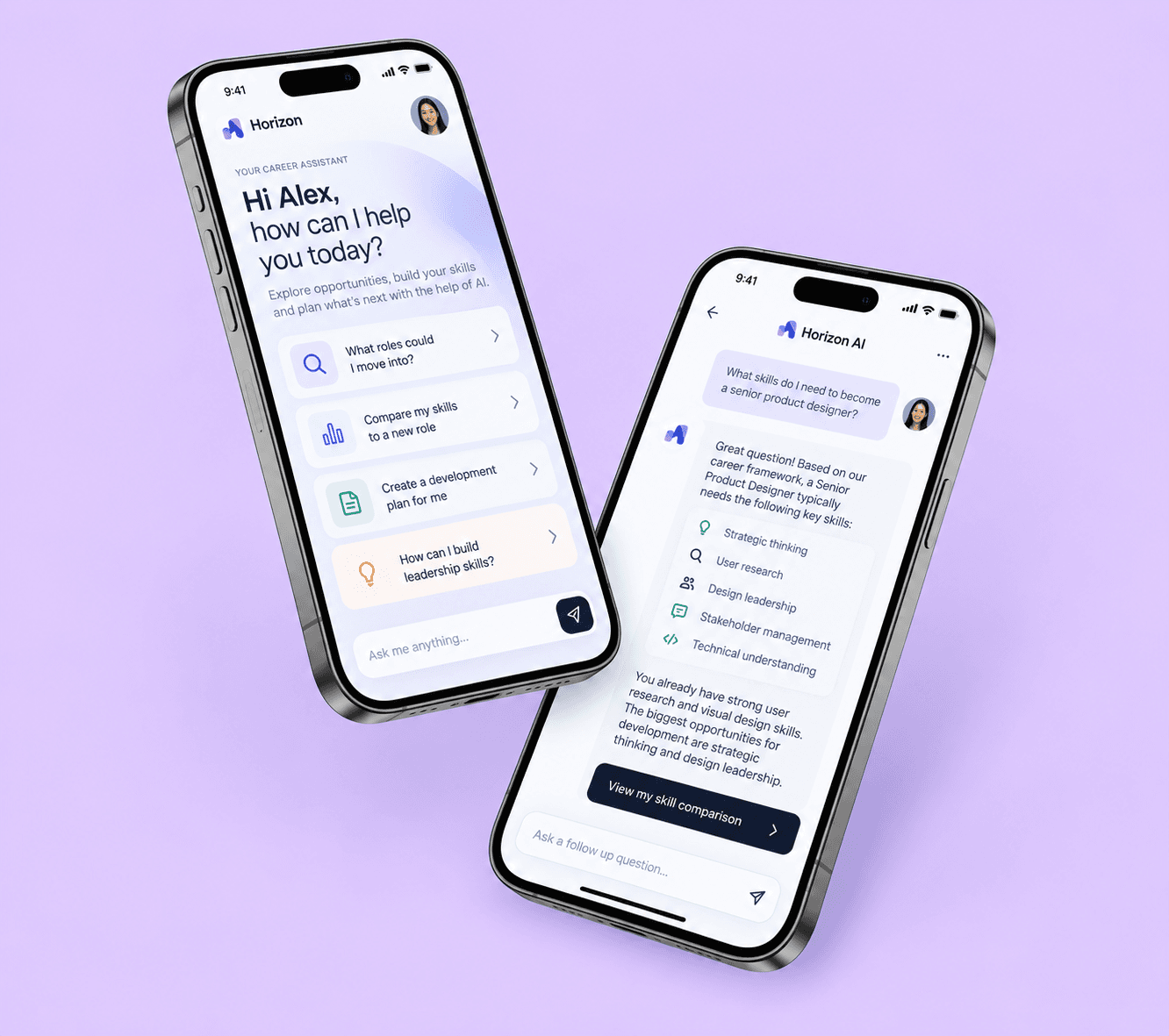
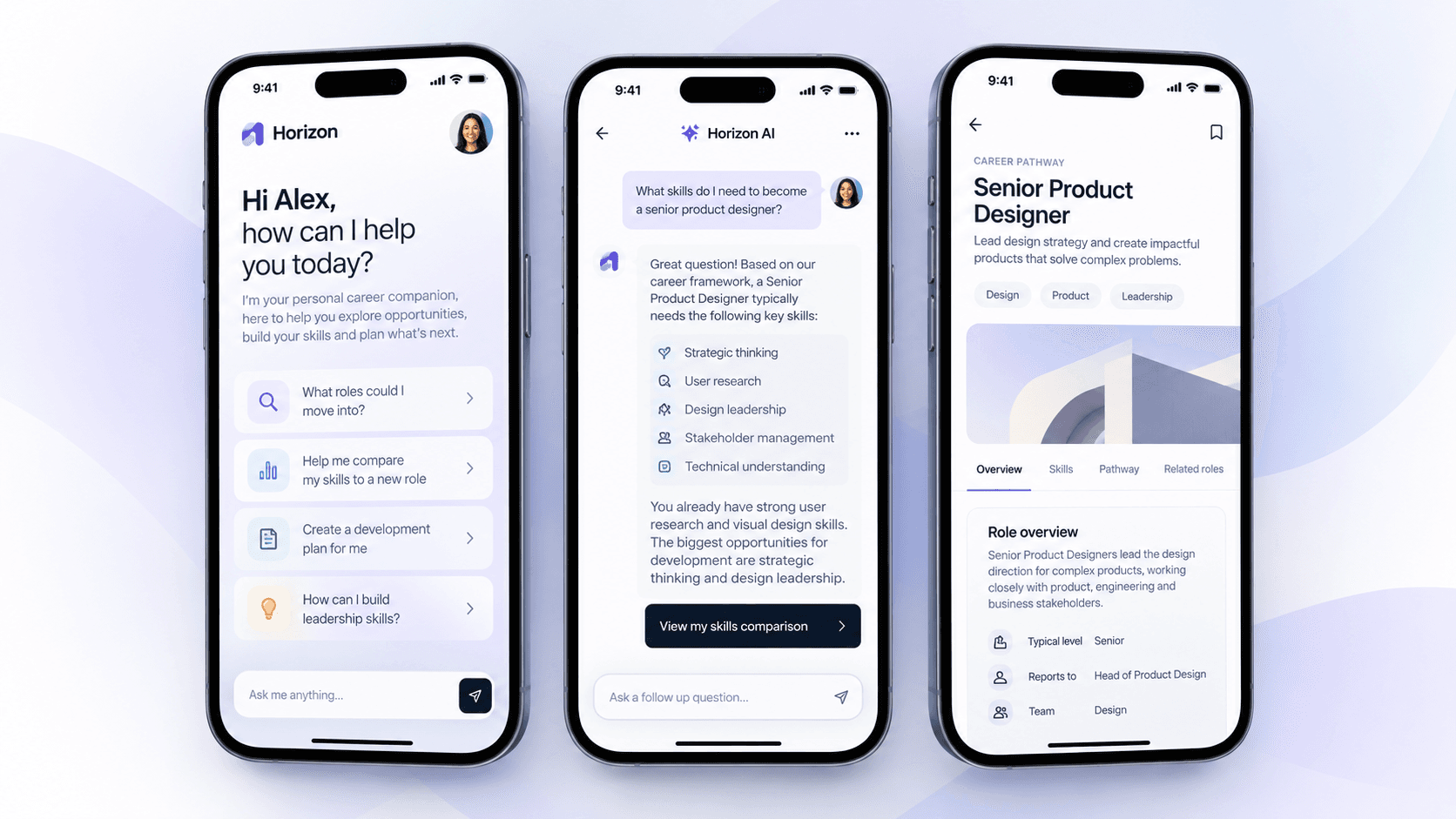
Imagine an employee being able to open a digital platform and ask:
What would I need to develop to become a team leader?
What other roles could suit my existing skills?
How does my current role compare with a position in another department?
Can you help me put together a development plan for the next six months?
Instead of searching through lengthy documents or navigating different HR systems, they receive relevant guidance based on their organisation's actual roles, competency requirements and career framework. A well designed platform could combine an intuitive web application with an AI assistant that helps employees explore opportunities, understand development requirements and take practical steps towards their ambitions.
But the opportunity is bigger than simply giving employees a chatbot, it's about creating a connected digital product where career exploration, skills mapping, personal development and workforce intelligence work together.
1. The employee benefit: Making career development personal and accessible
One of the biggest frustrations employees can face is not knowing what progression looks like. They might understand their current role perfectly well but have little visibility of opportunities elsewhere in the organisation, particularly outside their immediate department.
An AI powered career development platform could change that.
Career exploration
Employees could discover potential career pathways based on their interests, experience and transferable skills, including opportunities they might not have considered.
Skills gap analysis
A user could compare their current skills and experience against the requirements of another role. The platform could highlight strengths, areas for development and the expectations associated with different levels.
Personalised development plans
Rather than leaving a performance review with a collection of vague objectives, employees could build practical development plans with measurable goals, suggested learning activities and regular progress reviews.
Career guidance on demand
An AI assistant could help someone prepare for a development conversation, understand unfamiliar role requirements or explore how their existing capabilities might transfer into another area of the business.
More engaging ways to explore roles
Job descriptions only tell part of the story. Imagine interactive career maps, visual role profiles, illustrated working days or short videos helping people understand what different roles actually involve.
Crucially, the experience should put employees in control. Their private career exploration shouldn't automatically become information shared with their manager.
For employees, the benefit is greater clarity, confidence and ownership of their development.
2. The HR benefit: Better development, less administration and more useful insight
For HR Directors and People teams, the opportunity is equally significant. Many organisations already have substantial amounts of information about roles, competency frameworks, learning programmes and progression requirements. The challenge is keeping that information consistent, accessible and relevant while understanding what the business actually needs.
An intelligent career development platform could help in several areas.
A consistent framework across the business
HR teams could maintain approved role profiles, career levels and competency expectations centrally, helping managers and employees work from the same information.
Better development conversations
Managers could use structured role comparisons and agreed development objectives to support more meaningful discussions, rather than relying solely on subjective interpretations of what progression requires.
More targeted learning and development
With appropriate employee consent and data safeguards, HR could identify broader patterns in the skills employees want to develop and compare these with organisational priorities.
For example, if demand for leadership training is increasing, the People team could use that insight to plan relevant programmes and measure engagement.
Less repetitive administration
AI could support tasks such as preparing development plans, suggesting learning resources, summarising agreed objectives and helping employees find information independently.
A clearer understanding of capability gaps
Rather than relying entirely on periodic skills audits, HR teams could combine validated skills information with approved, aggregated development data to build a more current picture of organisational capability.
The aim isn't to replace HR expertise or automate important people decisions.
It's to give People teams more time, better information and stronger tools to support employee development.
3. The board benefit: Turning workforce development into business intelligence
This is where we believe the longer term opportunity becomes particularly valuable.
Traditionally, workforce development reporting has often focused on training completed, courses attended, engagement scores or annual appraisal outcomes.
Those metrics can be useful, but they don't necessarily tell a leadership team whether the organisation has the capabilities it will need in two or three years.
An intelligent skills and career development platform could help answer more strategic questions:
- Which capabilities are becoming increasingly important to our growth plans?
- Where are our biggest skills shortages likely to emerge?
- Which gaps could we close through development rather than recruitment?
- Where are we dependent on a relatively small number of people with specialist expertise?
- How might automation and AI change the skills required across different functions?
- Where should we prioritise our learning and development investment?
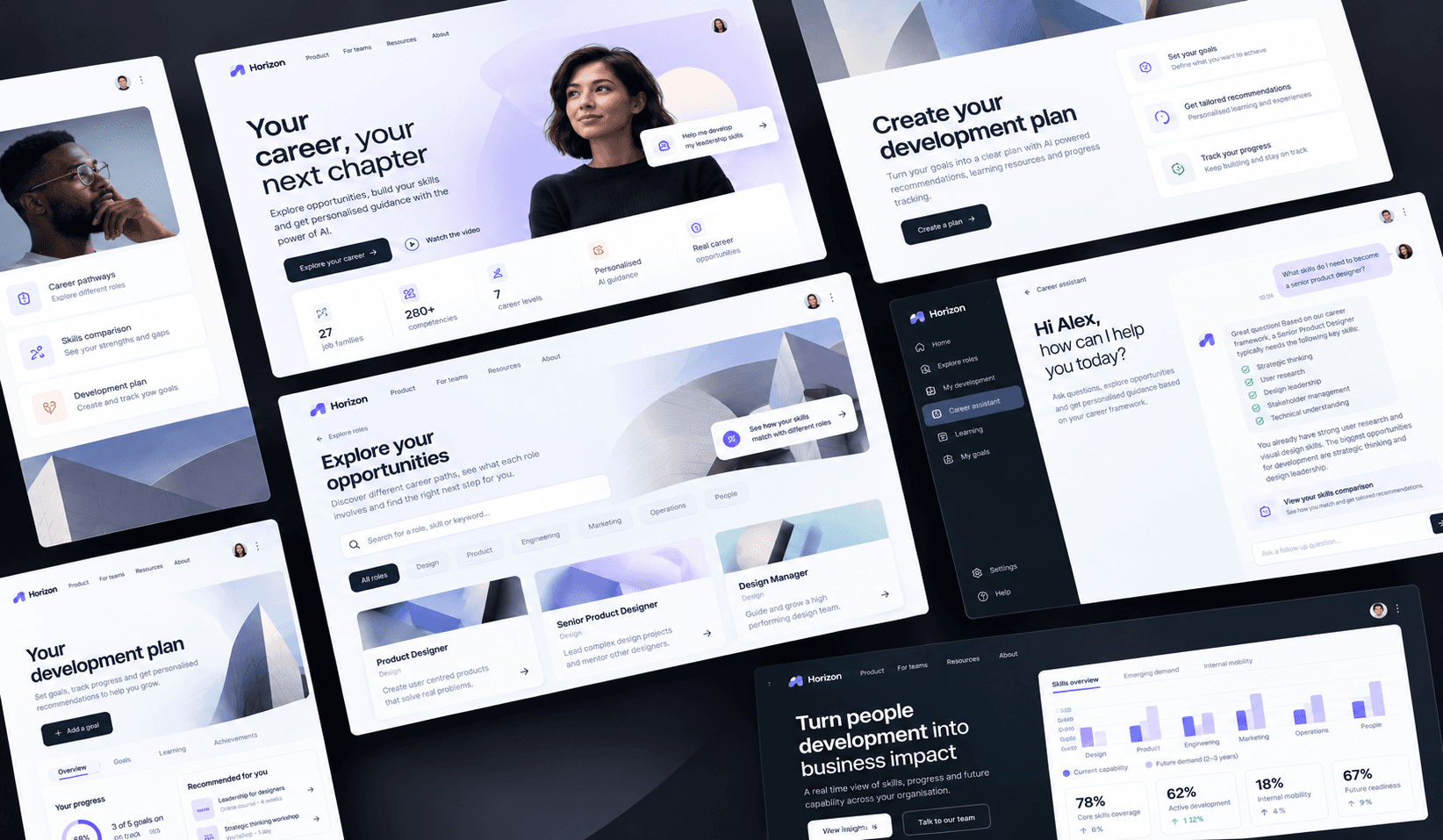
Imagine a board dashboard showing the difference between current workforce capabilities and those required to deliver the company's future strategy. A leadership team could explore scenarios, compare departments and identify opportunities to retrain or redeploy existing employees before investing in external recruitment. It could also support succession planning by highlighting where there is sufficient organisational capability and where further development may be required.
These insights would need to come from reliable, properly governed information, not assumptions made by an AI model. They should be presented at an appropriate aggregate level, with safeguards against identifying employees through small groups or sensitive data.
The real value is connecting people development with business strategy. That changes the conversation from 'How much did we spend on training?' to 'Are we investing in the skills our business will actually need?'
4. Helping organisations prepare for how AI will change jobs
There's another important dimension. AI isn't just creating opportunities to improve HR processes. It's changing the nature of work itself. Some tasks will become more automated. Others will involve people working alongside AI tools. Entirely new capabilities will become more important while certain responsibilities may change significantly.
This presents HR teams with a major workforce planning challenge. A modern career development platform could evolve to incorporate information about how roles and skills are changing, helping organisations identify where reskilling and upskilling may be required. For example, rather than simply showing an employee what skills they need for their next promotion, it could also help them understand how the requirements of their current role might evolve over time.
At an organisational level, this could inform investment in training, workforce redesign and longer term capability planning. Of course, predictions about future roles need expert review and regular updating. AI can help analyse scenarios, but it shouldn't be treated as an authority on which jobs will disappear or which employees will succeed.
5. What technology could power this?
The encouraging thing is that organisations don't necessarily need to replace their existing HR systems or invest in an entirely new technology ecosystem. Depending on their requirements, an AI powered career development platform could sit alongside existing HR, identity and collaboration tools.
For organisations using Microsoft, that might involve Azure, Microsoft Foundry or Azure OpenAI, Microsoft Entra ID, SharePoint and potentially Teams. Businesses using Google Workspace might explore Google Cloud, Gemini, Google identity services and integrations with existing Workspace tools.
Others may prefer an approach using AWS and Amazon Bedrock or a dedicated AI application connected to an existing HR system such as Workday, SAP SuccessFactors or HiBob, subject to the available integration capabilities.
The user experience could be built as a custom web application using technologies such as React or Next.js, supported by APIs, structured data and a suitable content management interface. The important consideration isn't which AI model is used.
It's how the platform brings together five elements:
- Reliable information: Approved roles, competencies, career frameworks and learning content.
- Intuitive experience: Clear interfaces that help employees understand and act on information.
- Intelligent functionality: AI that explains information, answers questions and supports development.
- Security and governance: Appropriate permissions, employee privacy, human oversight and controlled access.
- Meaningful reporting: Reliable, appropriately aggregated insights that help HR and leadership make better decisions.
For skills comparisons, structured rules should determine the actual requirements and differences wherever possible. AI can then explain those findings in a conversational, accessible way. This provides a more reliable foundation than simply asking a general purpose chatbot to interpret documents.
6. Employee trust has to be designed in from the start
One area we'd encourage every HR team to prioritise is privacy and trust. Employees need to know whether their conversations are private, what information is retained and when something will be shared with a manager. There needs to be a clear distinction between personal career exploration, development plans intentionally shared with colleagues and aggregated information used for workforce planning.
That means designing permissions, data minimisation, retention policies and appropriate controls into the product from the beginning. Organisations should also assess their data protection obligations, including whether a Data Protection Impact Assessment is required, and ensure that AI doesn't make consequential employment decisions without appropriate human oversight. A system that employees don't trust is unlikely to become a genuinely useful development tool, regardless of how sophisticated the underlying technology is.
7. Start small, prove the value and build from there
Our recommendation would be to avoid trying to deliver every possible AI capability from day one. Start with a clear business problem. perhaps employees struggle to understand career pathways. Perhaps managers need better tools for development conversations. Or perhaps HR needs a more consistent approach to identifying capability gaps.
Define the initial use case, validate the available information and build a working proof of concept using real, appropriately protected organisational data. From there, test the experience with a small group of employees and People team representatives. Measure whether the platform helps people find relevant information, build clearer development plans and have better conversations.
As the foundations mature, organisations can explore additional functionality such as learning recommendations, internal mobility opportunities, skills intelligence and strategic workforce planning.
The ambition should be to build something that becomes more useful over time, not simply launch another AI tool.
From HR technology to business value
We see a significant opportunity for businesses to rethink how career development works. For employees, it's about making progression clearer and giving people more control over their futures. For HR teams, it's about reducing friction, improving development and making better use of the information they already have. For boards, it's about understanding workforce capabilities and making smarter decisions about where to invest for the future.
At Show + Tell, we're interested in how thoughtful UX, digital product development and specialist AI engineering can come together to create applications that solve real business problems. If your organisation has ambitious plans for employee development, workforce planning or AI adoption, we'd love to explore what a more intelligent digital experience could look like.
Let's talk about what AI could make possible for your people and your business.
Related News